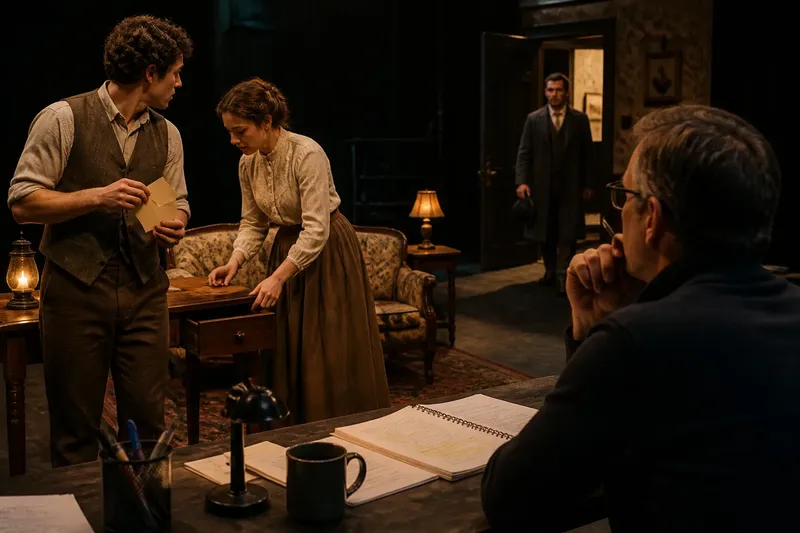
The Fixed-Set Myth: One Room Can Suggest More Than One Place
One room can suggest more than one place. Use a week of focused design choices to give each scene a clear identity without literal scenery.
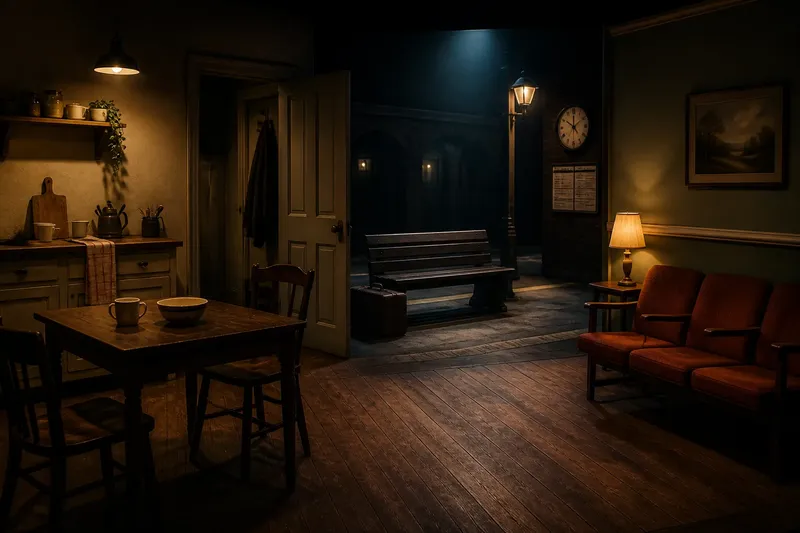
The rehearsal room has a table, three chairs, and a doorway, but the script moves from a kitchen to a station platform and then to a waiting room. A fixed set can carry all three scenes if the audience gets a few precise clues and enough room to imagine the rest. The practical task is not to build each location in miniature; it is to choose what must change, what can stay, and what the actors can make legible.
That choice is especially useful for amateur productions with limited storage, crew, or changeover time. Treat scenery as a set of cues rather than a row of complete rooms: a shift in light, one movable object, a changed relationship between performers, or a new sound can redirect attention. Over a week, the company can test those cues in sequence and settle on a shared visual language without turning rehearsals into construction meetings.
Start with the scene’s job
Before sketching a wall or shopping for props, ask what the setting does in each scene. A location may create privacy, expose a character to public view, make an entrance feel risky, or give people a reason to remain together. Those dramatic functions matter more than whether the audience sees an exact sink, ticket machine, or clinic desk.
Read the scene descriptions and stage directions alongside the dialogue. Mark details that affect action, such as a character hiding behind a counter, waiting for a train that never arrives, or being unable to leave without crossing another person’s path. Then separate those necessary details from decorative information. If the dialogue already tells the audience that the characters are at a station, a bench and an announcement may be enough; a realistic platform edge may add little.
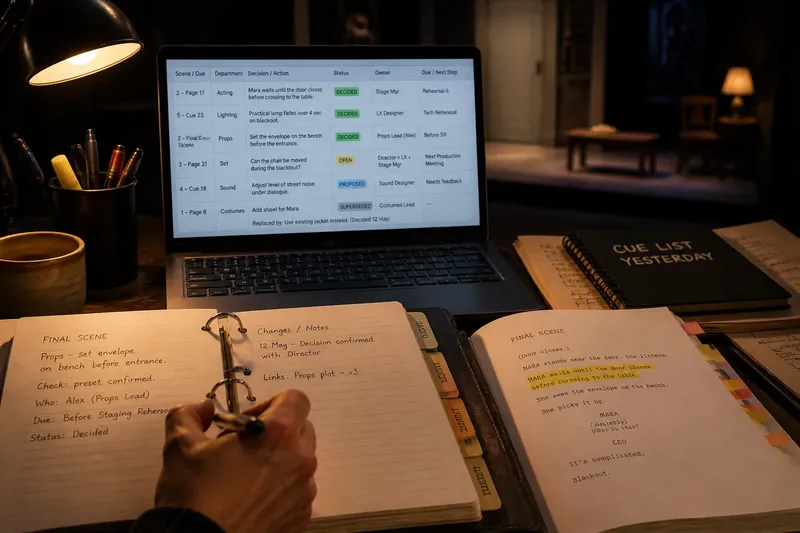
Make a simple scene map for the director, performers, and design team. List each location, its essential action, the visual clue that can carry it, and anything that must be reset before the next scene. Keep the map open to revision: it is a working tool for decisions, not a demand that every choice be solved before rehearsal.
Build a cue vocabulary
A small collection of recurring scenic signals helps the audience read changes quickly. Choose cues that are visible or audible from the back of the room and that the cast can handle consistently. A chair turned toward the audience may suggest a public waiting area; the same chair pulled close to a table may support a private conversation. A shift in light can sharpen the change, but it should not be the only sign if the venue has limited lighting control.
Think of the set like a well-used coat rack: the object stays put, while what hangs from it changes the impression. That does not mean every prop should become a symbol. Choose a few adaptable items with a clear practical use, then let blocking and performance do the rest. A length of fabric might serve as a curtain in one scene and a boundary in another, provided the audience can understand the change and the cast can manage it safely.
Agree on conventions early. If a hand-held object always signals a location, changing that object should be deliberate. If actors rearrange chairs in view of the audience, make that movement part of the staging rather than an awkward pause. The aim is not to hide every transition; it is to make each one feel intentional and readable.
A week of design decisions
First rehearsal day: Gather the director, designer or scenic lead, stage manager, and cast for a short script-based discussion. Make the scene map, note essential entrances and exits, and identify any setting details the text leaves uncertain. Do not settle those uncertainties by adding objects automatically. Write down the question, then see what the action requires.
Second day: Walk through the scenes with tape marks, rehearsal furniture, and available hand props. Give each location a proposed cue: a chair arrangement, a performer’s route, a sound, or a lighting state. Keep the room bare enough to move freely. If the cast has not yet established a scene’s physical action, use plain furniture rather than designing around a guess.
Third day: Run the transitions in order. Ask the stage manager to note what needs moving, who moves it, and whether the next scene can begin without a long reset. Look for cues that are difficult to see, require unnecessary handling, or contradict the dialogue. When a transition stalls, remove or simplify a scenic task before adding another crew member or prop.
Fourth day: Invite a few people who are not involved in the production to watch short scene pairs. Give them no explanation beforehand. Afterward, ask what places they understood and which cue helped them decide. Their answers are useful signals, not a vote: if several people miss a location, strengthen the clearest clue rather than filling the stage with literal detail.
Fifth day: Revise the cue vocabulary and run the scenes again. Confirm where each prop begins and ends, which furniture positions are repeatable, and how performers move between the imagined spaces. If a proposed change depends on a lighting instrument or sound system the venue cannot provide, replace it with a cue the company can reliably deliver.
Final rehearsal day: Use the actual playing area and the items intended for performance. Check sightlines from different parts of the audience, including whether a small object disappears behind a performer. Walk through every change at performance pace, then freeze the arrangement that works. Record the settled choices for the company, including who handles each movable item and where it waits when not in use.
When a scene needs more
Selective scenery is not an excuse to ignore the script’s practical demands. A scene may rely on a specific doorway, a window, a raised platform, or an object that characters use in a consequential way. If that feature affects safety, access, or the action itself, consult the venue and an appropriately qualified person before deciding how to represent it; follow the relevant equipment instructions and local requirements.
For other scenes, add detail only when a trial reveals a real gap. If the audience cannot tell that a character is outside, a door sound or a focused light may help. If the performers need a surface to write on, a table may be necessary even if the location is otherwise suggested. Distinguish the object that enables the scene from the object that merely decorates it.
Say a company’s script shifts from a family kitchen to a railway waiting area, and the rehearsal room has only a table, two chairs, and a small speaker. The team could keep the table for the kitchen, then turn one chair toward an imagined platform and play a brief station announcement as the next scene begins. The expected observable result is that spectators can follow the location change while the cast makes a simple transition, without a complete room being built for either place.
What should the audience understand?
Does every scene need a new backdrop?
No. A backdrop is useful when the scene depends on a visible boundary or image, but many locations can be established through actor positions, furniture, light, or sound. Keep the backdrop only if it clarifies the action more than it restricts the playing space.
How can actors make a bare set clear?
Give performers consistent physical cues: where they enter, what they face, and how they use the available objects. A purposeful route and a specific relationship to a chair or table often communicate more than an extra prop placed without action.
When is a prop worth keeping?
Keep it when a character handles it, the plot depends on it, or it provides a quick and understandable location cue. If it is used once only as decoration, compare the clarity it adds with the time and attention needed to move it.
What if the audience reads the location differently?
First check whether the dialogue or action already supports more than one interpretation. If the ambiguity is not intended, adjust one strong cue and run the transition again; avoid adding several competing clues at once.
Keep the room adaptable
A fixed set works best when the production treats each location as a clear agreement between text, performers, and design. Keep the essential objects close at hand, label storage discreetly, and note any furniture arrangement that must return after a scene. The stage manager can maintain that record, while the director and cast keep the physical choices alive in rehearsal.
As the week closes, review the scene map against the actual performance space rather than the image in anyone’s head. Remove cues that are hard to see or slow to reset, and protect the ones that make the story easy to follow. One room can hold several places when each change has a purpose—and when the production leaves the audience just enough room to complete the picture.