A Quiet Warm-Up for the Hour Before the Audience Arrives
A quiet pre-performance warm-up helps an amateur theatre company settle, check responsibilities and focus together without inviting rushed changes.
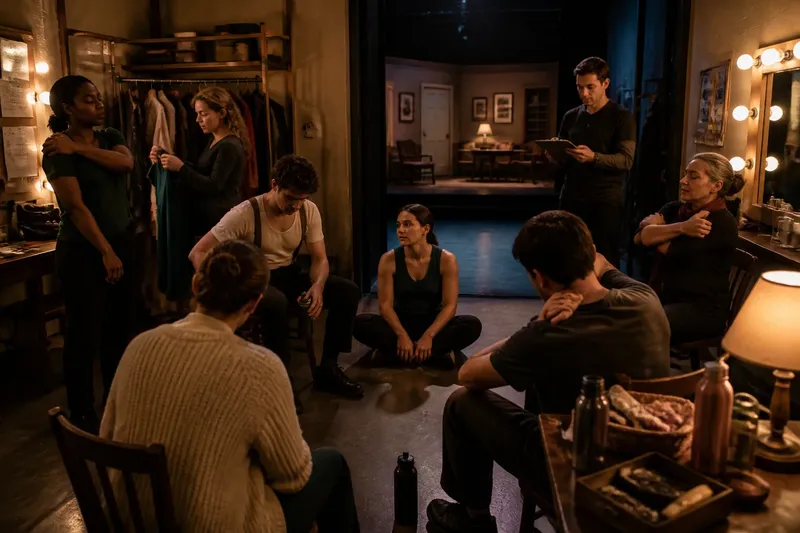
The house lights are still up, a prop is missing from its table, and someone has just asked whether the opening music is ready. A quiet pre-performance warm-up gives an amateur theatre company a shared sequence for the hour before the audience arrives: gather, focus, check responsibilities, then leave the production alone. Its purpose is not to add a final rehearsal. It is to help each person enter the performance with a clear next action.
One director or stage manager can shape the sequence, but the company should know it well enough that it does not depend on a speech or a single person’s memory. Keep the routine adaptable to the venue, cast size and call time. A calm structure works like a tray for loose keys: it gives each item a place, so the next person is not searching while the door is opening.
Set the room
Choose a gathering place that is away from audience traffic and does not block a backstage route. It might be a rehearsal room, a quiet corner of the dressing area or a cleared space near the stage door. Agree in advance where late arrivals should go and who will bring them into the routine without interrupting everyone else.
Use the first part of the hour for arrival, water, a bathroom visit and changing into costume if that is the company’s normal practice. People should be able to settle without being pressed to perform an exercise immediately. Ask everyone to silence personal devices and put them away unless a phone is needed for a production task. Keep conversation easy, but steer it away from new notes, scene debates and urgent-sounding speculation.
For a small cast, the whole group may gather at once. With a larger company, actors can arrive in a shared space while crew members continue their assigned checks. The stage manager should state where each group belongs and when they will reconnect, so quiet does not become uncertainty about who is responsible for what.
Choose a steady sequence
A useful routine moves from individual settling to shared attention, then to practical readiness. Keep each part familiar and brief enough to leave room for the work that genuinely belongs to the venue. The sequence can include:
- Arrive: Let people put down belongings, get water and change without being called into a circle while they are still in transit.
- Ground: Invite a few slow breaths, gentle stretching or a quiet moment of attention. Offer options rather than requiring a particular exercise or asking anyone to explain a personal need.
- Warm the voice and body: Use familiar, low-pressure activities suited to the production. A company might hum comfortably, articulate a short passage or loosen shoulders and hands; this is preparation, not a test of range or stamina.
- Reconnect: Share a simple group cue, such as a brief check-in or a moment of silence, so the company shifts from separate tasks to a common focus.
- Review: Confirm practical responsibilities and the call to places, then end the group gathering on time.
The exact exercises matter less than consent, accessibility and consistency. Someone with a sore throat can listen rather than vocalize; an actor who prefers not to close their eyes can keep them open. Avoid intense vocal or physical work at this point. A warm-up should make the next action feel approachable, not demand a display of energy.
Make the check concise
The practical review is not a chance to inspect every detail together. It is a quick handoff: the person responsible confirms what is ready, and the person coordinating the show knows where a concern should go. Actors may check their own costume pieces and props. Crew members follow their established pre-show duties. The stage manager or designated caller confirms the communication path and the timing of the call.
Keep the review to items that affect the company’s ability to begin as planned. Useful questions include: Are the required people present or accounted for? Does each person know their next cue or task? Is there an unresolved issue that needs the responsible person now? If something needs attention, send it directly to the appropriate person rather than opening a group discussion.
Say you are directing a small play in a community hall, and an actor notices that a hand prop is not in its usual place. The actor tells the stage manager, who checks with the person assigned to props and reports whether the item is ready or whether the established alternative is needed. The rest of the cast continues the warm-up instead of searching backstage or inventing a change together. The observable result is a clear owner for the problem and a company that can keep its attention on the performance.
Do not add last-minute artistic notes during this check unless an immediate correction is essential for the performance to proceed safely and coherently. A late suggestion about pace, gesture or a line reading can unsettle an actor without giving them time to work with it. Save useful observations for a later rehearsal. For technical or safety matters, follow the venue’s procedures and the instructions of the responsible qualified person.
Keep the focus humane
Calm does not mean silent, and the same ritual will not suit every person. Some performers settle through quiet; others need a friendly exchange or a little movement. Set boundaries around volume and timing, then allow people to make small choices within them. A director can say, “Use this time to arrive in the way that helps you focus; we’ll gather for the shared check in a few minutes.”
Do not turn a check-in into a demand for emotional disclosure. A simple “ready,” “need a minute,” or private word to the stage manager gives people a way to communicate without putting them on display. If someone raises a concern, listen, clarify what action is needed and connect them with the person who can address it. The group does not need to solve every discomfort in the circle.
Accessibility belongs in the design of the routine, not as an exception added at the last moment. Offer seated and standing options, avoid requiring touch, and make spoken instructions easy to hear. If the venue is noisy, use a visible cue or gather in a quieter location. Adapt the activity to the company rather than treating a particular breathing, movement or vocal exercise as mandatory.
When should the warm-up change?
What if the company arrives at different times?
Set a shared arrival window and give late arrivals a quiet way to join without restarting the whole sequence. The stage manager can brief someone individually on the current point and any practical responsibility they need to know.
Should the cast rehearse difficult lines?
Actors may privately review a line or use a familiar vocal exercise, but avoid turning the gathering into a scene rehearsal. If a passage repeatedly needs work, schedule that work in rehearsal rather than asking the company to solve it in the hour before the audience arrives.
What if a real problem appears?
Send it to the person responsible and follow the production’s existing procedure. The warm-up should pause only if the issue affects whether the performance can proceed; the stage manager or designated lead can then tell the company what they need to know.
Can the routine be shorter?
Yes. Preserve the order that matters most: arrive, settle, reconnect, confirm responsibilities and receive the call to places. Remove optional exercises before compressing the practical handoff into confusion.
Close with a clear cue
End the gathering with one predictable signal and a direct instruction: where to go, what happens next and who will call the company. Avoid a long motivational address. A calm “Thank you; please move to your places” can be more useful than another round of reminders, especially when each person already knows their task.
After the performance, note only what would improve the routine next time: a quieter gathering spot, a clearer handoff or more room for arrivals. Keep that adjustment separate from the performance’s artistic review. A reliable pre-performance warm-up is not a promise that every evening will feel easy; it is a practical way to let people gather, prepare and begin with fewer avoidable surprises.